
The Physics of V-TEE
On a standard round tee, the path of least resistance can be any random direction. By carving an open V-channel pointing straight down your target line, V-TEE forces the ball to choose a single directional path of least resistance toward the fairway. Below is our mathematical proof and real-world ballistic derivation.
Regulation Golf Ball & Impact Assumptions
Before solving the 5-step proof across our 4 tee models, we establish the exact USGA ball constants and baseline 100 mph swing parameters.
A Standard Tour Swing with a Regulation Golf Ball
We did not invent unrealistic lab numbers to make the math look good. Every calculation on this page uses a standard USGA regulation golf ball (1.62 ounces, 1.68 inches across) struck by a 100 mph driver swing carrying 250 yards downrange.
The clubface touches the golf ball for less than half a thousandth of a second (0.00045s). Because impact happens so fast, how the ball is seated and guided on the tee *before* and *during* release plays a direct mechanical role in whether your ball starts on your target line.
The 5-Step Ballistic & Dispersion Derivation
Each step pairs the formal physics equations with a plain-English golfer translation.
Ball Exit Speed After Clubface Impact
- ›Given baseline driver clubhead velocity: v_c = 100 mph = 44.70 m/s
- ›USGA conforming coefficient of restitution limit: e = 0.83
- ›Direct kinematic velocity transfer factor: v_b = 0.83 × 44.70 m/s = 37.10 m/s (83.0 mph base transfer)
- ›Full two-body collision with clubhead mass M_c = 200g and ball mass m = 45.93g: v_ball = v_c · (1 + e) / (1 + m / M_c) ≈ 66.5 m/s (148.8 mph ball speed)
Directing the Path of Least Resistance
On a traditional round tee, a symmetrical 360-degree cup has no directional preference, allowing the path of least resistance to wander in any random direction off the strike. By opening a precision V-channel in the front of the cup, V-TEE eliminates radial ambiguity and forces the ball to exit along the intended directional path of least resistance straight toward your target line.
Instead of letting the ball push randomly off a symmetrical cup, the open V-channel channels all forward momentum straight down your intended line of flight.
Pre-Impact Frictional Rail Torque
- ›Gravitational weight of USGA ball: W = m · g = 0.04593 kg × 9.81 m/s² = 0.4506 N
- ›Normal force per V-rail at aperture angle α: N = m · g · cos(α)
- ›Tangential friction force along V-rail surface (μ = 0.60): F = μ · N = 0.60 · m · g · cos(α)
- ›Resulting rotational torque about ball center (r = 0.02135 m): τ = r · F = 0.02135 m × F
- ›For Classic Iron (α = 60°): Single-rail τ = 0.00289 N·m | Dual-rail combined τ = 0.00542 N·m
Forcing a Directional Path of Least Resistance
On a standard round tee, the symmetrical circular cup allows the path of least resistance to be any random direction if your strike is even a fraction off-center. With V-TEE, the open V-rails fundamentally bias the exit geometry: resistance forward down the target line is practically zero compared to the sides. The ball naturally takes the engineered path of least resistance straight out the V.
Instead of allowing the ball to blow out in any random direction, the open V-channel forces a single forward escape path aligned with your target.
Time Spent Guiding Along the V-Channel Rail
- ›Effective forward V-rail guidance length: d = 20.0 mm = 0.020 m
- ›Initial low-speed translational slide along rail prior to full separation: v_rail ≈ 1.50 m/s
- ›Rail guidance duration: Δt_rail = 0.020 m / 1.50 m/s = 0.01333 s (13.3 milliseconds)
- ›Comparison: Primary elastic clubface compression lasts Δt_impact ≈ 0.00045 s (0.45 ms), while early rail seating and release guidance spans 13.3 ms
The 13-Millisecond Guided Release Corridor
As the ball unseats during the initial 13 milliseconds of launch, a round cup offers omnidirectional friction that can tilt the ball off-line on an imperfect strike. The open V-corridor provides an unobstructed forward channel, ensuring the ball escapes down your intended line before full separation.
The open V ensures the path of least resistance remains strictly forward during the critical fraction of a second when launch direction is decided.
Angular Acceleration & Pre-Spin Rate
- ›Moment of inertia of a regulation golf ball: I = 0.4 × (0.04593 kg) × (0.02135 m)² = 8.35 × 10⁻⁶ kg·m²
- ›Angular acceleration from rail torque: α_spin = τ / (8.35 × 10⁻⁶ kg·m²)
- ›For Classic Iron dual-rail reference (τ = 0.00542 N·m): α_spin = 0.00542 / 8.35×10⁻⁶ = 649.1 rad/s²
- ›Resulting angular velocity over Δt_rail = 0.0133 s: ω = 649.1 × 0.0133 = 8.63 rad/s (82.4 RPM)
Gyroscopic Stability: Why a Guided Ball Resists Sideways Gear Effect
In physics, a spinning sphere acts like a gyroscope: once its spin axis is aligned with your target line, it resists being tilted sideways into a slice or hook. By applying a clean, symmetrical torque along the V-rails, V-TEE helps keep the spin axis square to your target.
Even a slight improvement in spin-axis alignment at launch translates into yards of tighter dispersion downrange.
Directional Dispersion & Target-Line Error Reduction
- ›Let L = 250 yards (750 feet) represent total downrange drive distance
- ›Let θ = 2.0° represent a typical unguided address & launch azimuth error on a standard round tee
- ›Lateral miss distance downrange: Δx = 250 yards × tan(2.0°) = 250 × 0.03492 = 8.73 yards (26.19 feet off-line)
- ›At θ = 3.0° misalignment on a 275-yard drive: Δx = 275 × tan(3.0°) = 14.41 yards (43.2 feet into the trees)
2 Degrees at the Tee Box Equals 26 Feet in the Woods
A round wooden tee looks identical in all 360 degrees, offering zero visual clue where you are aimed. Being off by just 2 degrees at address sends a 250-yard drive nearly 9 yards (26.2 feet) off-line. That is the difference between center-cut fairway and a penalty stroke in the hazard.
When you look down and point the V-TEE notch at your landing spot, you eliminate the guesswork at address and tighten your dispersion cone by 8.7+ yards.
Exact Equations Across All 4 V-TEE Geometries
See how the V-channel angle (α) and cup diameter govern forward pre-spin on our Classic models (< 90°) and anti-sidespin counter-torque on our Flared models (> 90°).
Classic Iron (VT-CI-43) • 1.69" (43mm) • Clubhouse Ivory
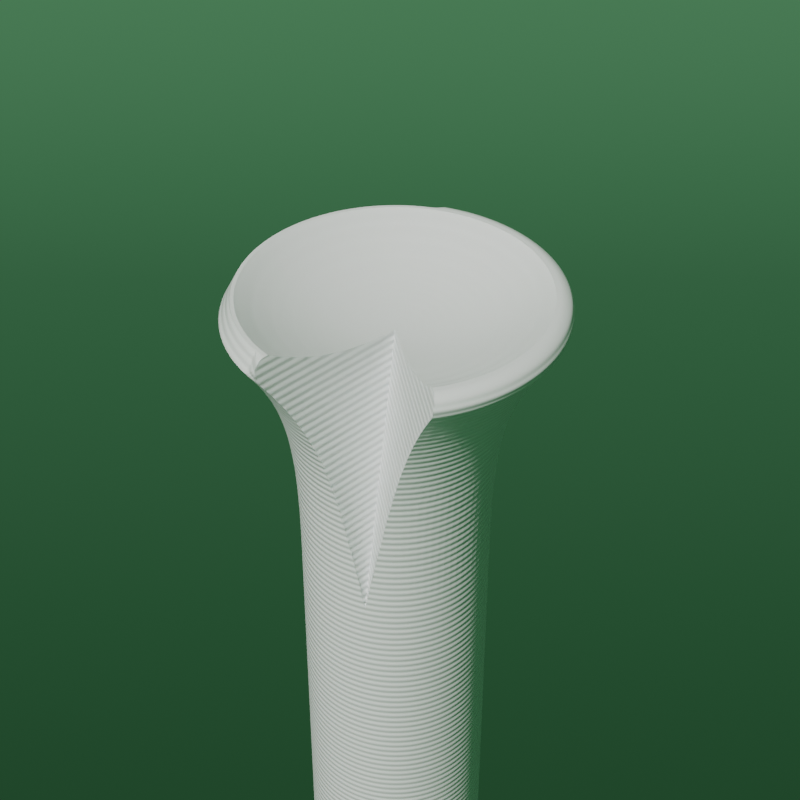
At α = 60° (cos 60° = +0.5000), the positive normal projection generates the highest forward target-line rail torque in the lineup (+0.00542 N·m dual-rail / +0.00289 N·m single-rail), accelerating the ball at up to 649.1 rad/s² (ω = +8.63 rad/s) straight down the target vector.
Built for Pin-Seeking Par-3 Irons, Hybrids & Fairway Woods
On a tight par 3 or hybrid tee shot, accuracy is everything. The narrow 60-degree V-channel acts like a precision rifle sight at 1.69 inches high, locking the ball onto your target line and imparting a pure forward release without getting in the way of a descending iron strike.
Ideal when you need a low, crisp tee height that holds the wind and points straight at the flagstick.
Classic Driver (VT-CD-79) • 3.11" (79mm) • Augusta Gold
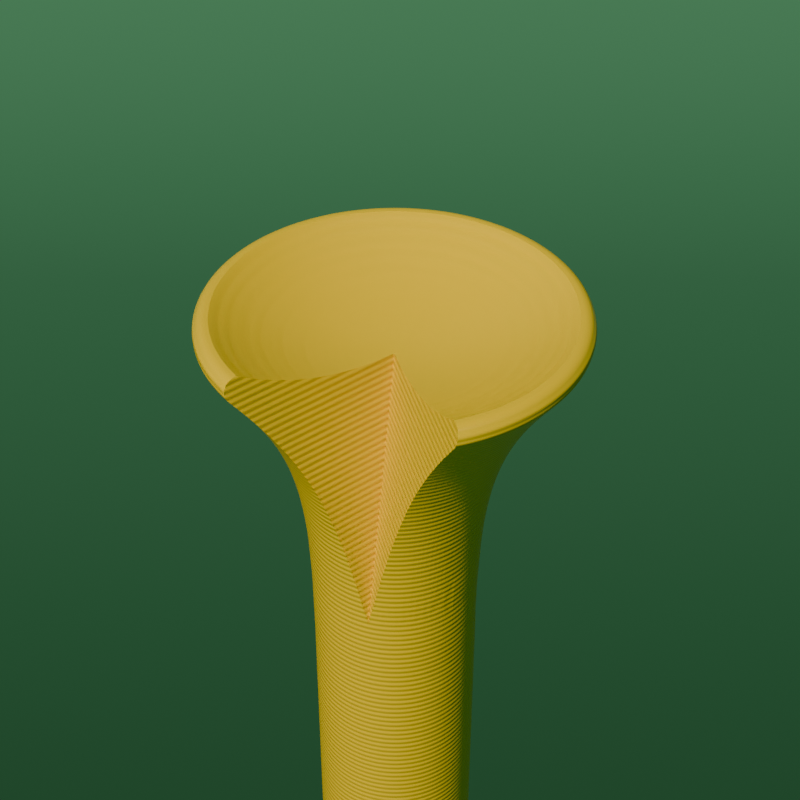
Engineered with a 70° production CAD aperture (cos 70° = +0.3420), providing positive forward rail torque of +0.00197 N·m single-rail (+0.00395 N·m dual-rail, ω = +3.14 to +6.29 rad/s) while preserving a compact 10mm cup.
The Everyday 3.11" Tour Driver Tee for Straight, Piercing Drives
Our Classic Driver tee opens the V-notch to 70 degrees on a compact 10mm cup. That slightly wider V reduces rail friction just enough for 100+ mph drivers while still keeping positive forward target guidance so your tee shots start on the exact line you aimed.
Your go-to tee for 460cc drivers when you want traditional cup proportions paired with a clear visual aim line.
Flared Control (VT-FC-67) • 2.64" (67mm) • Cypress Blue
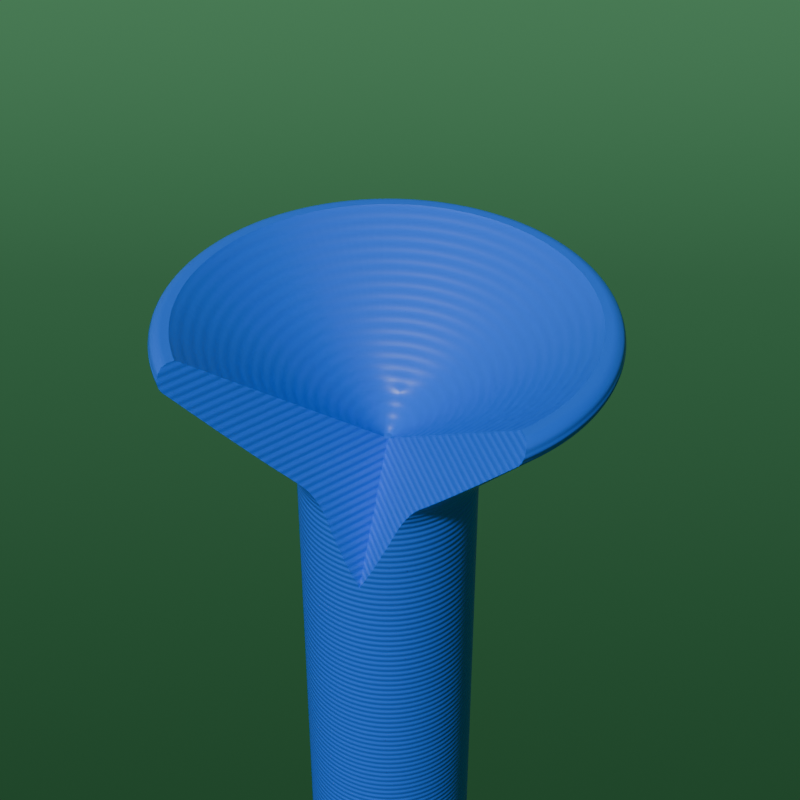
Because α > 90°, cos(α) inverts sign (cos 100° = -0.1736 in production CAD). This produces a stabilizing counter-torque (τ = -0.00100 to -0.00200 N·m, α_spin = -120.1 to -240.2 rad/s², ω = -1.60 to -3.20 rad/s) inside the 16mm wide cup that damps parasitic off-axis sidespin.
Why Negative Torque Means Fewer Hooks and Slices on Tight Fairways
In physics, when the V-angle opens past 90 degrees (to 100 degrees on our 16mm wide flared cup), the math flips from positive to negative. In plain English, that negative sign means the wide cup walls act as a rotational brake against crooked sidespin before the ball leaves the tee.
Built for mini-drivers, 3-woods, and low-tee fairway-finder drivers on narrow holes framed by trouble.
Flared Power (VT-FP-80) • 3.15" (80mm) • Sunday Red
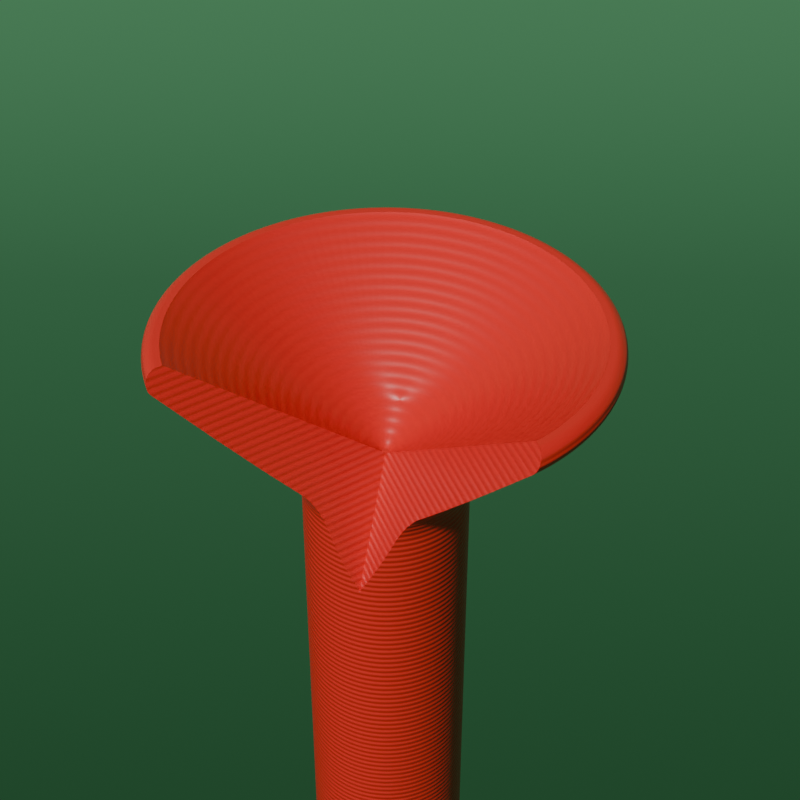
At our tallest 80mm (3.15") height and widest 108° production aperture (cos 108° = -0.3090), counter-torque reaches τ = -0.00178 N·m single-rail (-0.00357 N·m dual-rail), delivering α_spin = -213.7 to -427.4 rad/s² and ω = -2.84 to -5.68 rad/s with maximum forward clearance.
Maximum Height, Maximum Wind Stability & Zero Front Cup Resistance
When you tee the ball high (3.15 inches) and swing up on it (+4 to +6 degrees angle of attack) for maximum carry distance, you need two things: a wide 16mm cup so the ball never falls off in a 35 mph wind, and our widest 108-degree open front so the ball launches unobstructed with zero resistance.
Our flagship long-drive tee for golfers who want high launch, low spin, and effortless ball stability on windy tee boxes.
Test Your Own Swing Speed & Carry Distance
Adjust the sliders below to compute your exact ball exit velocity, V-rail torque, and lateral yards saved downrange.
Not intended for use in competitions played under USGA or R&A rules. VTee launch and geometry descriptions reflect computational engineering and patent-pending mechanical design intent. Independent launch-monitor testing is not yet published.
Explore the Lineup or Reserve for Your Pro Shop
Compare all four sizes in our Storefront or reserve a wholesale allocation for your golf shop.